Monday, November 24, 2025

Red Box Rabbit Hole Part 2: Cribbing From Everywhere

In Part 1 of this rabbit hole I discussed my experience playing some solo 'Basic D&D' using a battered copy of the Red Box and the BSOLO Ghost of Lion Castle module.

Having enjoyed that quite a bit I went rummaging through my various, collected, TTRPG related materials for some way to keep adventuring. 

Making a Map 

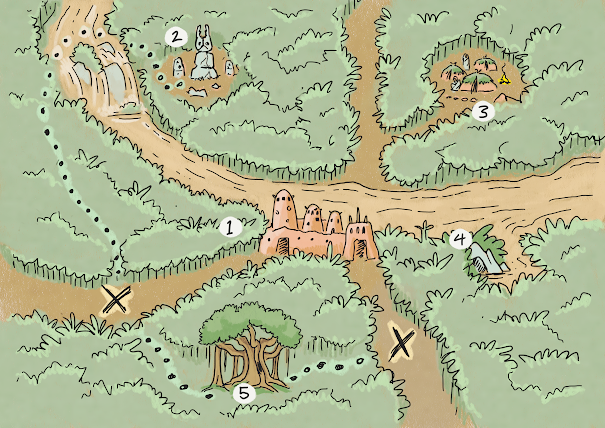
I decided I needed a world map to go looking for adventure in. I hand draw some hexes on some A3 and put Lion Castle on the map using the description of its location from the adventure. Then I start dropping dice on the map to see what's where. This is similar to the method used in the mapping game Cartograph. The number on the die corresponds to types of terrain or other features. You draw those onto the map roughly where the dice fall (overlapping hexes in my case). The list I run with at first is:

1. Mountains

2. Hills

3. Forest

4. Lake (two lakes at once indicate a river)

5. Swamp (I later swap this out for plains)

6. Special feature (Roll again for: 1. village 2. Town 3. Ruins 4. Cave 5. Tower 6. Stones) 


When I'm done I have this:


Fairly generic but I'm not going for anything too original here. I want that feeling of place from early D&D - where this might be fantasy Wyoming or some other midwest meets Tolkien vibe. I'm not exactly sure what I'm doing with the hexes. I run with the idea that you could move two hexes on from the one you're in during a standard days travel if you have a road. 

I start in Launam (manual backwards because I'm naming things based off the first bit of text I see) on the river that cuts through the NE quarter of the map. Then I go looking for trouble. 

I want a dungeon to delve into. I remember that I have a zine I picked up at local zine fair with an empty dungeon map on it (pictured below). 

Crawl zine by doodlebotdan (Daniel Purcell) 


You can see the makers insta handle on it.  As near as I can figure out their name is Daniel Purcell - so thanks Dan. 

Useful Tables 


To populate Dan's map I make use of the following tables in the Red Box Dungeon Master's Rule Book:  

Room contents and random treasures table from Red Box DM's Rule Book


For traps and special results there are lists or examples elsewhere in the book, (you can see the some of the entry on traps in the top right). I just pick a die to match the number of options and roll. 

For monsters I use the wandering monster tables in the same book. 


To avoid it be a hack'n'slash slog, (and to add some intrigue), I use a BECMI reaction roll table for the monsters on the back of an old DM's screen that was also gifted to me with the Red Box:


There are simpler tables for this but - I encountered this post  by Eric Diaz outlining how the nested tables create a, sort of, RP mini game in which player characters can try and sway the outcome of the next roll with a +1 or +2 here and there. I can vouch for this being very much how it played out for me. Having a patrol of 6 Goblins surround you and then having a tense conversation through gestures and offers of rations in the hope of surviving is pretty exciting. 

Oracle Dice 


A final mechanic that helped introduce some imaginative fluidity to things was the use of oracle dice for those, 'what if', elements of the game that tables can't fully account for. 
This involves asking a question - e.g "Can these goblins unlock this door for us?" and then rolling dice to get a yes or no. I used this system by Matt Jackson. 


How'd it go? 

The experiment worked fairly well. I was able to play through Dan's zine dungeon, rolling for what I encountered as I went in ways that preserved some suspense and gave my characters some interesting scenarios to deal with. At one point a skeleton jumped out of a coffin and started asking riddles so I had to google a riddle generator. At another point I found an NPC in a cupboard and talking with her using the oracle dice generated a whole scenario for the rest of the dungeon. I feel these sorts of systems work best with some willingness to interpret the results in playful ways - 'what would be cool and make sense with this result?' etc.   

Afterward I was hungry to use these mechanics in a great big dungeon. So I started to mock up a table for generating one.

That'll be the focus for Part 3 of this rabbit hole.  

Thursday, November 20, 2025

Red Box Rabbit Hole - Part 1: Ghost of Lion Castle

I first got into D&D in mid 2014. A friend bought the new, Lost Mines of Phandelver, starter kit and asked if I would consider running it for him. This was my first exposure to TTRPG's and I caught the bug pretty hard. This same friend was introduced to D&D by his dad who ran games for him and his brothers when they were kids. 

I DM'ed that starter campaign for my friend and a group that eventually included five other players. In a climactic session in Cragmaw Castle we were even joined by his dad (who played an orc monk). 

Sometime after that my friend handed me a box of old D&D material that his dad wanted to donate to the group. It looked like this: 


The Red Box - with art by Larry Elmore


Inside was a bunch of older D&D modules from the 80's and the DM's Rule Book and Player's Manual for the basic set (part of the expanded Basic-Expert-Companion-Master-Immortal collection or BECMI).
This was really exciting - some ancient treasure or arcane lore connected to this game of ancient treasures and arcane lore. I enjoyed leafing through the old yellow pages and looking at the retro aesthetics of D&D in the 80's, (so much Farrah Fawcett hair  and chain mail that looks like lycra!), but in terms of incorporating this stuff into my game - I didn't see how. I was looking for session content rather than different ways to play and whilst these books had goblins and evil wizards etc I couldn't quite decode the stat blocks or convert them easily to my 5e game. 

Fast forward a decade and I'm more aware that some people really prize elements of what they call 'Old School' D&D. I'm not really sure who might be reading this, (this isn't really an OSR blog given that most adventures I've made are for 5e), but if the Old School Revival isn't a familiar thing to you, you can get a bit of a primer by reading the Principia ApocryphaThe upshot is that some procedures and principles, with which D&D has formerly been played, produce a very different experience which, (although it can be deadlier and involve tracking things like torches and encumbrance), can be pretty fun.  

With me so far? Alright, so...

 A week ago the podcast Between Two Cairns reviewed an old module from the 80's called 
BSOLO The Ghost of Lion Castle
. Now it's time for that dog eared old box from my friend's father to reenter the story because guess what one of the modules sitting inside was...


Ghost of Lion Castle by Merle M. Rasmussen


I gently took it out of its resting place and got ready to read ahead of listening to the review. This is were I made my first discovery:

"Hey, this is a solo module!" -  So now I've decided to play it instead of just read it, which means I have to start looking more closely at those old rule books. This is great! I'm finally giving this thoughtful gift from my friend's dad some propper time. I pick a pregen character (they're all magic usesrs) and head to the gates of Lion Castle... 

(mild spoilers for the adventure ahead) 

I die. 

I try again - and die three more times. 

At this point I'm feeling skeptical about the module. I'm all for high lethality but having your 3hp character die to a portcullis you have no choice but to pass under doesn't feel fantastic.  

But I persist. I get lucky with the portcullis and also snag some magic items that give me something to work with. I start mapping the space on some grid paper - a central conceit of this module is that your character has a magic map and journal that teleports back to the starting tavern when you die so future adventurers can learn from your mistakes. At this point I'm getting quite into the mapping (see below):


Mapping Lion Castle


The space is starting to become coherent to me and I'm figuring out safer paths through the castle without getting into risky encounters with monsters (seriously, it's like a quick draw competition - lose initiative and you're dead). 

I'm actually having a lot of fun. Partly because of the module, partly because I'm getting to take some older rules for a spin but also because I'm getting to play a character in a world which, as a pretty commited GM, I don't often get a chance to do. 

I'm definitely not doing everything 'right'. Should I be adding a dexterity bonus to this? What number does this monster need to roll for a save? Why the hell does a portcullis require a 'save vs wands'!? But I run with what makes sense and keeps the game moving. 

Then, as my character stands in a dark corner of the dungeon, contemplating what to do next, I see something written on the entry for the room I'm in:


The body of Cortayo


'The body of Cortayo' - The name is the same as one of the pregens. I've recorded the deaths of other characters I've played on my map but I didn't want to write in this fragile old booklet. This must be the body of my friend's, father's character, waiting here for something like 40 years before anyone else played the adventure and discovered it.

I get very excited and look around for someone to tell but since there's nobody I make a note to tell my friend about it and then look up what equipment the pregen has on them. 

By now I'm pretty hooked on solo dungeon delving. But once I solve the secrets of Lion Castle I don't have any more vintage solo dungeons to play. I have modules for group play but it's not the same, as the front loaded info for a GM takes a lot of the suspense out of the experience and they're pretty hard to run without having some of that to hand.    

Part 2 of this rabbit hole will be about how I used a blank dungeon map from a zine fair and the tables in the basic Dungeon Masters Rulebook to have a follow up adventure for the character who survived Lion Castle. 

For now I'll leave you with the dry bones of Cortayo on entry L.65 

To be continued.  

Wednesday, July 16, 2025

Tomb of the Immortal Grolk


Tomb of the Immortal Grolk is a one page dungeon I've made for this year's

One Page Dungeon contest. You can download it for free HERE.

I'm reasonably happy with it although I haven't had a chance to play test it yet - I've had plenty of time to sit and draw lately but not much opportunity to get my players together.

I've had the idea of a giant rolling head that fills passages and turns the dungeon into some sort of reverse Pac-Man game for a while. The theme of this contest being 'Never split the party' was a good prompt to flesh it out. 

Hopefully GMs can piece together a flow for the dungeon from what's on the page (that's the point of one pagers right?) but I'm going to be indulgent and lay out a few thoughts on what I'm going for in this blog post. 

Lore: 

I imagine Grolk as an endlessly regenerating, destructive and creative force much like mythological giants such as Ymir or Pangu. I think even Grolk's destructive acts are generative in ways that mirror natural events e.g. volcanic eruptions creating fertile farmland, supernovas generating more complex elements etc.  

The image I have in my head is Grolk splitting the moon with his axe and a dark ocean of nightmares pouring down over 'earth'. 

Such violent, creative events are pretty inconvenient if you're already alive and trying to build a society. I imagine the forces of order or balance did their best to decommission the non-stop novelty machine that was Grolk. 

This sort of epic backstory suggests an enormous scale for Grolk that isn't quite matched by what looks like a 10ft diameter head and a... 9ft? axe - but maybe Grolk's physiology is fairly elastic. Maybe the axe changes size like Sun Wukong's staff. 

Factions: 

Like a dutiful osr/nsr accolyte I want there to be a counterbalance of forces and motivations existing in this dungeon before the party are dropped in it. 

 I see three potential factions here:

1. Grolk -  Dismembered both physically and psychologically and and striving to be whole. Endless apetite, maximum chaos. 

2. The Tomb Builders The Spiders - Since the spiders are activiely subduing Grolk with venom and webs it follows that this is a mission they are dedicated to. All I say on the sheet is that they're telepathic but I actually think they'd be something like a monastic order - dutifullly guarding this ancient threat in an almost ritualised way. They may even hold ceremonies down there. I don't know how you get from the statues in the corridors above to spider monks but it's fun to think about. So they're faction number two - dedicated to keeping Grolk subdued. But they're also spiders - giant hungry spiders that would love some diversity in their diet. 

3. The Fachans - A Fachan is a one eyed, armed and legged scottish monster. In this dungeon they're little and made out of adventurers that've been bisected by Grolk's axe. If I got split into two, wretched, little weirdos I'd want to get back to normal. I don't think that's an option for most fachan's here. Perhaps their other half was eaten by a spider, or has been further split into worms, that were then eaten by other fachans. It'd be a pretty rough situation. They could jump into Grolk's mouth with any another fachan and be reborn as some 'new' person but that might not be the easiest choice to make. So they're here, surviving, burrowed into the walls to stay out of the way of the head and the axe and the spiders. I think their role could be as merchants of a sort. Their tunnels emerge near a 'town' and they've probably horded any equipement dropped in the dungeon. They could barter with the PC's to supply things like rope or light sources. I particularly like the Oubliette for this. Instead of just being trapped a PC could bargain with some fachans, through the hole in the wall, to get something that might help them. I'm not entirely sure if they'd eat a helpless adventurer... 

Why is the party here? 

  1. They've been pushed down the hole by townspeople as punishment for crimes they may or may not be guilty of. 
  2. They heard there was loot down here (there is). 
  3. Grolk's heart's blood can cure curses or diseases.
  4. They saw this hole and wanted to check it out. 
Extending this dungeon: 

I have a few ideas for how Grolk's tomb could be expanded. 

1. A Spider Monastery.  Have the elevator open onto a small complex of rooms that establish these wierd spiders and their whole deal: some cucoons, a chapel, some statues or murals showing the transition from human acolytes to spiders. Perhaps they kept little spider hives like regular monks keep bees? 

2. Some catacombs for the heroes depicted in the statues on the top level. Magic weapons, more lore, perhaps some restless/undead heroes. This should maybe be the top level, or perhaps the secrect passage, between the two statues, also heads towards a secret tomb. 

detail from The Garden of Earthly Delights by Heironymus Bosch

3. A pit of combo-mutants. Give the botomless pit a bottom and have some interesting monstrous folk living on the shores of a blood lake. You can have two headed humans but also spider centaurs or half spiders or spiders with a fachan merged in there so they have a human eye, arm and leg somewhere. This can be a real Bosch-fest. What if a local church pays them to run a, 'hell themed', theme park? Just a thought. 

Ok that's all - If you play this let me know if it hangs together. As soon as I get to play it I'll update this blog with some thoughts.  


Sunday, July 6, 2025

A mini, jungle village, point crawl

I've made a small point crawl set around a village on the banks of a jungle river.

 The main hook revolves around travelers getting shaken down by mysterious bandits on their way in and out of town. The village doesn't know where these outlaws are coming from or disappearing to. 

I'd originally wanted it to be a single, (or double sided), page but as I tried to connect the dots, and make the underlying relationships work it became evident that it wouldn't fit in that kind of space. I could go through a 'kill your darlings' phase and refine things down but I'd intended this to be a quick experiment after making Grotto of The Golden Gargoyle. I'm sharing it as is for anyone to play with or pull ideas from. In some ways it currently feels like a bit of a mash up of themes across the first six zines in the perils series - I'm evidently drawn to doppelgangers, swampy environments and 'infection' as concepts... 

Note: I haven't had a chance to play test this material yet. I imagine it as a bit of a sleeper adventure that could slowly emerge alongside something else the party are doing in and around the town. 
 
Also, if you're one of my players don't look at this.
 
OK here it is:

Conspiracy in Lutum  (working title) 


Friday, May 30, 2025

Grotto of the Golden Gargoyle (Perils issue #7)

Pocket Sized Perils Issue #7 is here! 


It's been a hot minute since I posted here and even longer since I put out an adventure but here it is:

Grotto of The Golden Gargoyle 

clicking the pic above will take you to my page on itch.io 
 
This is the 'G' entry in the Pocket Sized Perils series (there's an alternate one hidden in the recesses of my drive that may join it someday).  I've made quite a few changes to the format and general approach this time around... 

1. It's system agnostic (not 5e)
2. It's less pocket sized (a longer PDF or print on demand book, as opposed to a fold'n'cut zine) 
3. It's more heavily OSR inspired than previous entries

Why not 5e? 

Like a lot of people, 5e was my entry point into TTRPG's and I have a lot of affection for it as a system. However since first cracking open the PHB  I've discovered there's a very, VERY, big world of games and gaming styles out there. I've dabbled with a bunch of different systems and in particular find myself gravitating to simple rules that facilitate creative play. That is to say; simple characters doing unique stuff together in the fiction rather than complex characters, (mechanically speaking), doing the same stuff, most of the time, regardless of the fiction.  I'm not dogmatic about it though. Fun is fun and different ways of playing have different strengths. 
 
 Why the longer format? 

 In exploring other modules and writing connected to ttrpgs I've really enjoyed the rich world building and detail some adventures or settings offer. Consequently I wanted to build more environment focused adventures, where parties could explore more and decide how to interact with the world rather than follow something like a three act arc. 

The work of Jennell Jaquays and Justin Alexander's writing about it was a particular inspiration. 
The Grotto was designed with loops (maybe too many), secrets, factions and verticality in mind. It's still a smallish dungeon but all those elements are present in some form.  

This is my 'goblins in a cave' adventure 
 
I just wanted to do it once - 'there are many like it but this one is mine'. Much like my soft spot for 5e I have a soft spot for trad fantasy tropes. I came to table-top games pretty late, so I still have a an itch to play with elements I've seen in fantasy in other media through my childhood. I'll definitely move on to weirder stuff from here but I can't go past G and leave 'Goblins' on the table. 

As a teaser for the adventure itself here is the goblin npc generator included in it: 

Sunday, November 5, 2023

A Wizard's Tower

A Wizard's Tower


I recently stumbled upon an image of a wizard's tower from one of my old home games. It was a fun environment for the players to navigate so I thought I'd pop it up here.

I often style my wizards as obsessively nerdy about a particular field. The wizard who built this tower is really into creating animal-human hybrids a la The Island of Dr Moreau. Continuing the Moreau theme I placed the tower on a floating island entirely populated by the wiz's bio engineered monstrosities. Even the plants were designed - as the players walked through the tangled mangroves I described the canopy of leaves turning in unison to catch the wind and steer the island on its mysterious course.

In classic mad scientist fashion the wizard has been eaten by rebellious frog people and their tower is... dormant. This set up left the players relatively free to poke around and put together the situation. 

From bottom to top here's a breakdown of the rooms. 

A Golden Barge

The Golden Barge


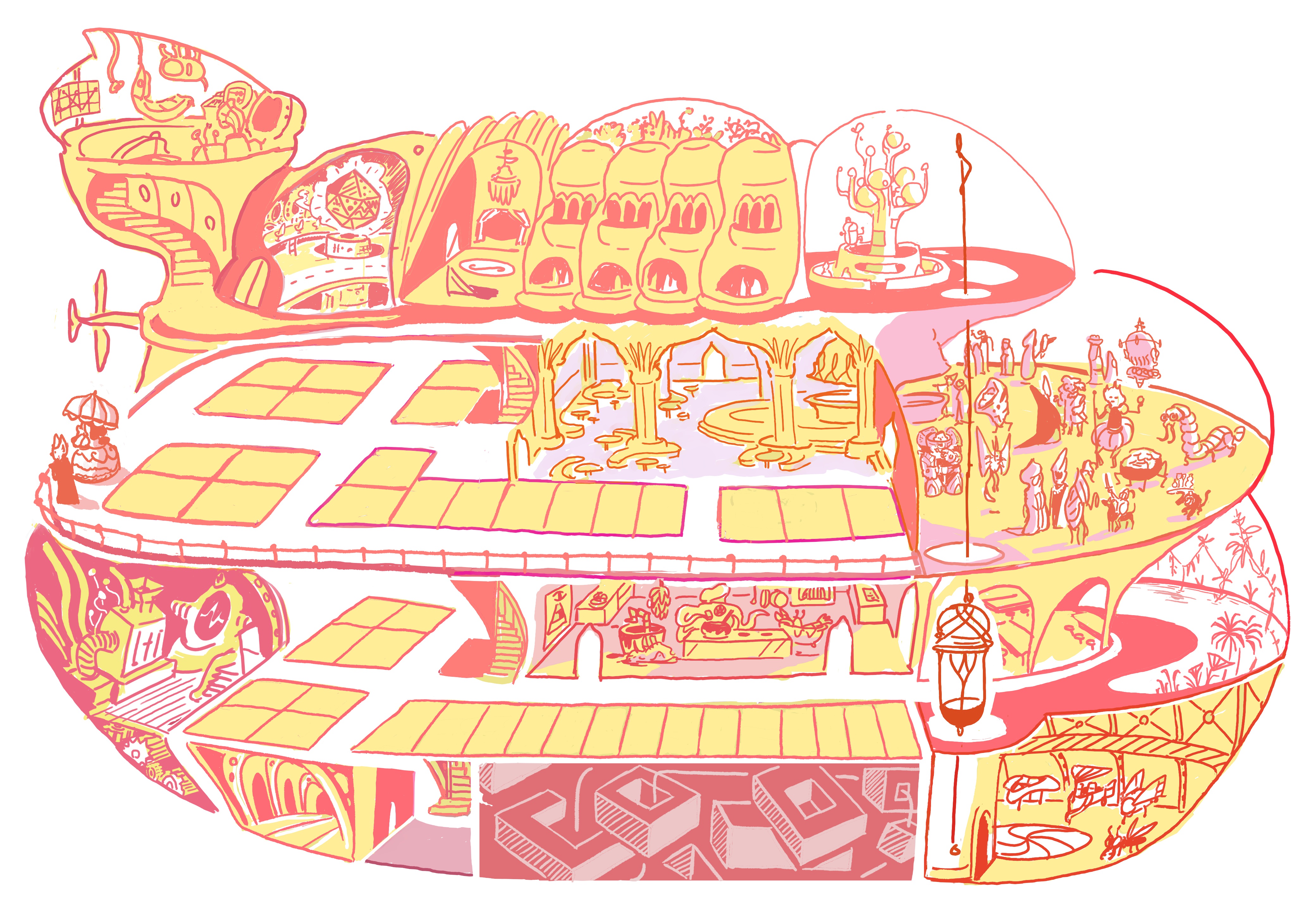
    The Golden Barge spools its way along a luminous thread through the humpbacked sky. 

On the prow, under the sheen of a translucent dome, tiny figures are moving…


I've been meaning to get into Troika by Daniel Sell for a while. The PDF has been sitting in 

my dropbox  but till now I've only rolled a few characters and enjoyed the art 

by Dirk Detweiler Leichty and Andrew Walter.

 
That changed this weekend when I set sail on a Golden Barge and dipped a toe into the system 

with a few friends. 


I'm pathologically unable to run a module in any system and couldn't help home brewing up a

quick one shot. Above is my attempt to map one of the Golden Barges eluded to by the rules 

(more than lightly influenced by Leichty's fantastic illustrations). I had hoped to actually make

 this post a rough outline of that adventure but I'd need to work further on my understanding of the 

system and the bones of the adventure itself for that to be worth your time. Instead, in the spirit of

Troika, I offer you this map as an invitation to your own imaginations. 


I'll include these two room descriptions I drafted for the session. 


The Kitchens


A fury of shouts and flames, a spicy assault on the senses - a cadre of inevitable chefs are busy cooking orders. 

They have been recruited from a fanatical culinary sect that will stop at nothing to spike any ticket that comes into the kitchen. An army might march on its stomach but these chefs will  lay waste to entire spheres to serve canapes. Only once a meal is served will they return to their  regenerative cocoons until service hours resume. 


The Hangar

It takes a lot to traverse the spheres. The assorted craft here aren’t up to the task - being more suited to 

a quick jaunt or occasional maintenance of the barge itself. The options in each bay are as varied 

as the passengers themselves. 


1. A Gossamer pleasure skiff - great for being seen whilst seeing the sights.


2. A large insectoid with mouth parts like a garbage disposal. Its compound eyes seem to shift from you 

to the saddle hanging nearby. 


3. A vapor ski - perfect for enjoying the humpbacked sky at the expense of everyone else.


4. A Scorpedo Rum Runner in jailbreak blue. There is a pistolet in the glove box and a person in the trunk. 


5. A two person, pedal powered, velocipede.


6. A Gronk class sky tug - solid as a bathtub full of concrete and just as maneuverable.